NEVER GONNA GIVE YOU UP
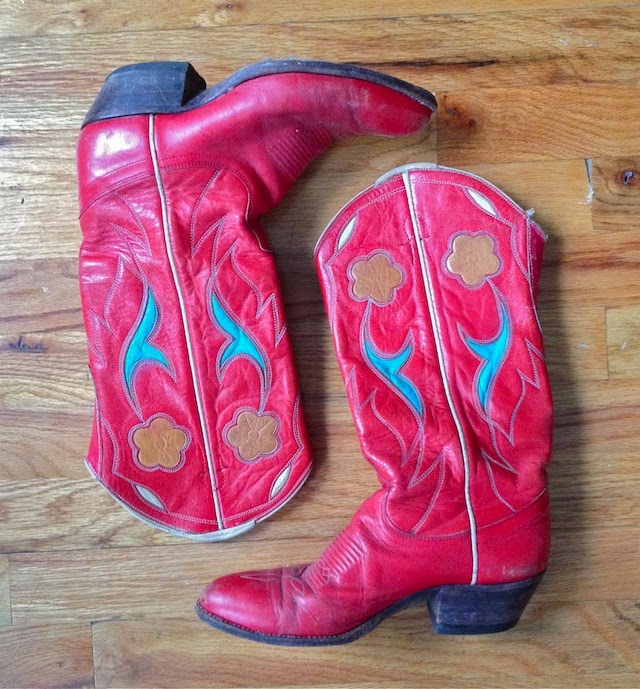
I found these countrified babies in the basement of my ex-boyfriend's parents place in Jonesborough, TN. His mom was an antiques dealer and had all kinds wacky things stored away in the subterranean depths of her ranch style house. I bought them from her for $4 in a slick exchange of cash, slipped them on my style starved feet and never looked back. Yippy ki yay motherfuckers.
CHELSEA, NUEVA YORK 7.8.14


From top: Gallery view at Gagosian // Jocelyn Hobbie, Untitled, 2014 // Franz West, Caino va incontro ad Abele, 2010 // Ridley Howard, Pink
Portrait, White Frames, 2014 // Tara Donovan, Untitled, 2014 // Georg Baselitz, Lehr nich ratte much wilm (Lelf bal wile), 2013 // Robert Rauschenberg, Untitled (Early Egyptian), 1974 // Mickalene Thomas, Carla, 2014
THE LEGEND OF CHARLES JAMES

Portrait of Charles James by Michael A. Vaccaro, 1952, Image Courtesy of The Metropolitan Museum of Art
The perfectionism of his practice was honed and developed over a career spanning some fifty years, from his beginnings as a milliner in Chicago, to opening up his first dressmaking business in 1928, to the years spent in London and Paris where he began to establish himself as a significant designer and artist among contemporaries such as Christian Dior, Elsa Schiaparelli and Cristobal Balenciaga. Back in New York, his very own workroom and salon on Madison Avenue was open by 1945, and by the early 1950s he was at his peak of popularity and production. His dressmaking skills, which proved him to be simultaneously a designer, sculptor, engineer and architect, were, at their peak, most realized in the cleverly engineered ball gowns he created postwar. Voluminous dresses with names referencing the perfection of nature, the ‘Tree,’ ‘Clover Leaf,’ ‘Swan’ and ‘Butterfly’ were all examples of James’ tireless tinkering with sartorial ideas and executions.
During his lifetime the Anglo-American designer was well aware of the lasting significance of his work for legacy and teaching purposes, and as early as the 1940s encouraged some of his most loyal patrons to donate their Charles James garments to the Brooklyn Museum. It is with this collection of nearly 200 garments and 600 related materials, the bulk of which was transferred to the Metropolitan Museum of Art’s Costume Institute in 2009, along with an additional donation of items in 2013, that this unprecedented collection of one designer’s works is the subject of Charles James: Beyond Fashion. Co-curated by Harold Koda and Jan Glier Reeder, the exhibition is presented in three galleries: the new Anna Wintour Costume Center, Carl and Iris Barrel Apfel Gallery and special exhibition galleries on the museum's first floor.

First Floor Special Exhibition Gallery, "Charles James: Beyond Fashion," Image Courtesy of The Metropolitan Museum of Art

Projection screens with rolling content designed by Diller Scofidio + Renfro (DS+R)
It’s
impossible not to gaze into the looking glasses installed on either side of the
main gallery and not see one’s reflection alongside an infinity landscape of
Charles James dresses. There are dresses, dresses and more dresses but also one
continuous line of quotes from the designer etched pale white into the glass
and hovering in the darkness. Upon first glance into the mirrors the viewer
sees James’ philosophies literally embedded into the clothes. ‘Brancusi has his medium; Picasso,
Faulkner, Shostakovich, theirs,’ one quote says, ‘Mine happens to be cloth.’ James’ words are given
importance and used as a design element throughout the exhibition, strewn
across the designers’ sartorial gifts like ribbon, tying the show together in a
lovely package.
Charles
James: Beyond Fashion contains too many gifts to name, but one of special
note is the artist’s famous Clover Leaf dress, two examples of which occupy
centralized positions in the main gallery. A one of a kind version of
the design in pink silk faille, copper shantung and black silk lace was
designed for Josephine Abercrombie, the only daughter of a Texas millionaire,
while its black and white iteration was created for Mrs. William Randolph Hearst
Jr. to wear to Eisenhower’s inaugural ball in 1953. That same year the dress
also saw the coronation of Elizabeth II in London. Weighing in at ten pounds,
but supposedly comfortably balanced on the hips when worn, the gown is
breathtaking in its sculptural beauty.

“Clover Leaf” Evening Dress, 1953, White silk satin, white silk faille, black silk-rayon velvet
The Metropolitan Museum of Art, Gift of Elizabeth Fairall, 1953
Though the glamorous formal gowns he created for the stylish elite are his most well known works, James’ signature lines and architectural forms are certainly evident in his daywear. Startlingly modern in his exploration of spirals and wraps, an early design from 1932 for the contemporary urban woman, the ‘Taxi Dress’ in a ribbed black wool knit was intended for the wearer to easily slip on and off while en route in a cab. In addition, his carefully considered touch in green-gray silk satin brought to life the ingenious ‘Figure-Eight Dinner Dress,’ (1939), with two sides of fabric attached to a waist piece spiraling around each leg. A swath of delicately draped evening and cocktail dresses from the 30s and 40s and folded suits and coats from the same period evoke both western and eastern artistic themes, classical sculpture and Japanese origami. An array of coats and dinner suits showing James’ virtuosity with form and cut were also on display.

"Anatomical Cut" Suits, Anna Wintour Costume Center, Lizzie and Jonathan Tisch Gallery.
The suit in Green wool twill was donated by Lee Krasner Pollock in 1975.
After Charles James’ many plans and notes for his own autobiography went unpublished after his death in 1978, the designer has finally gotten his due, not only with the exhibition Charles James: Beyond Fashion, but with a book of the same name out this year by The Metropolitan Museum of Art and published by Yale University Press. In its prologue, penned by America’s sole couturier Ralph Rucci, Rucci puts into words the enchanting physicality that I first felt when viewing James’ work for the first time. Describing an ‘extraordinary realm […] where vision and proportion take precedence over artifice and trend,’ perhaps the magic in his works is that they look like clothes, but aren’t merely. They are as Rucci puts it, ‘three-dimensional sculptures that come alive once on a woman’s body, because James was ever mindful of the woman wearing the shape.’ And so it is that the woman once wearing the shape decades ago and gasping for air to fit into a Charles James’ dress was sharing a similar reaction to the lucky viewers of this exhibition, where every fold, curve, drape, reflection of light and recesses of shadow on his pieces incites gasps for breath.

Charles James Ball Gowns, 1948. Courtesy of The Metropolitan Museum of Art, Photograph by Cecil Beaton
Beaton / Vogue / Condé Nast Archive. Copyright © Condé Nast
Possibly more than any designer exhibition the Met has shown, the Charles James retrospective displays the garments as art; works just as sculptural, architectural, carefully considered and meticulously crafted as the Greek and Roman marbles in the nearby galleries. Add to that its innovative and didactic approach to display, which stands as a compelling example of fashion exhibitions in the 21st century. With its accompanying social media, lectures, workshops, tours and the amount of visual/audio resources and study material online, the perfecting designer himself would be quite impressed with the curators attention to the maintenance of his legacy. As he himself said, ‘Forget all you know & learn something every day.’ #CharlesJames


SUNDAY BEST
.jpg)
I suppose most folks make an effort on Easter Sunday to not look like a completely run-down dirty shame. It is a day, much like Kentucky Derby day, when in fact the sartorial gods make extraordinary allowances for grandeur. So it wasn't such a surprise that I spotted what looked like a matriarch of Chinese royalty on the Grand Street subway platform that afternoon.
After the initial shock and awe of seeing her lush Kelly-green fur coat, I wondered what shade of rouge she had smeared on her Clara Bow lips. This dame meant business. Who knows what she had concealed within the deep recesses of that swag? A flask of Baijiu? A pearl encrusted compact for impromptu face powdering? Several tiny clementines with the leaves attached? I thought to ask to take her picture but became way too shy in the presence of such extraordinary pomp and fluff.
When the train arrived she floated over to an empty seat near a window to stare out into the dark tunnels between stations along the way- the shadows, graffiti, haphazardly arranged lights hanging from thick dusty cords. And somehow the seat next to her was empty. As she lost herself in the window view I got a quick snap of her coat with its rolling hills and valleys of shiny green fur like waves of grass in the countryside. Spring had sprung.
PEP IN THE STEP

Noritaka Tatehana, Lady Pointe shoes, 2012, The Museum at FIT

"That one is so hot!" exclaimed a 10 year old little girl, her sticky hands and warm breath fogging up the glass case housing seven pairs of heels and platforms from Givenchy and Alexander McQueen. She was lost in a well ordered labyrinth of tall vitrines, spotlights above, shoe specimens all around. There were plenty of comments to be heard in the vast black space. Whispers, deadpan exaltations, a whole dictionaries worth of interjections, memories, opinions. Apparently people have lots to say
about shoes. Particularly women's shoes. And why shouldn't they? Lately their heights, shapes and manner of
ornament have reached even further into the realms of cult status. So far even, that the word "obsession" following the word "shoe" seems a commonplace catchphrase.
The Museum at FIT's latest grand scale exhibition "Shoe Obsession" displays examples of this feverish love for elevated toe tappers, and the variety here is quite impressive. Covered in exotic leathers, dyed suede, beaded and studded, buckled and buttoned-- I'll admit, my heart went aflutter when I entered the main gallery. Co-curated by Dr. Valerie Steele, director and chief curator of MFIT, and Colleen Hill, associate curator of accessories, along with Fred Dennis, senior curator of costume, the exhibition aims to examine "our culture's ever-growing fascination with extravagant and fashionable shoes." It notes significant cultural influences such as Sex and the City for eliciting a broader awareness of fashionable shoe designers, and showcases the private collections of a select group of female collectors, among them Baroness Monica von Neumann, Lynn Ban and Daphne Guinness.
If the curatorial intent here is to delve into our psychic attraction to outrageous shoes, the exhibition itself only skims the surface, giving the viewer more eye candy in the form of stilettos and clodhoppers than substantive accompanying texts. The show's matching tome, published by the Yale University Press, nicely fills in these cracks with essays by Steele and Hill, profiles of private collectors, and over 150 color photographs. As a living, breathing exposition of artifacts, however, both the small and large galleries (the latter seen below) are both simple and breathtaking. With so many styles seemingly floating atop steel totems, encased in glass, the "ooh!" factor certainly enraptures the audience, who for a moment allow time to stop as they glide from case to case, wide eyed and curious, noses up against the glass, pulses accelerating.
If the curatorial intent here is to delve into our psychic attraction to outrageous shoes, the exhibition itself only skims the surface, giving the viewer more eye candy in the form of stilettos and clodhoppers than substantive accompanying texts. The show's matching tome, published by the Yale University Press, nicely fills in these cracks with essays by Steele and Hill, profiles of private collectors, and over 150 color photographs. As a living, breathing exposition of artifacts, however, both the small and large galleries (the latter seen below) are both simple and breathtaking. With so many styles seemingly floating atop steel totems, encased in glass, the "ooh!" factor certainly enraptures the audience, who for a moment allow time to stop as they glide from case to case, wide eyed and curious, noses up against the glass, pulses accelerating.

Main Gallery, "Shoe Obsession", Image courtesy Museum of FIT
GRAPHISME

Ruby Jean Wilson in an ad for Jacobs' Spring 2013 Collection

Still from William Klein's, Qui êtes-vous, Polly Maggoo? (1966)
I'll admit, I was a little jealous when I saw Marc Jacobs latest spring
collections for both Louis Vuitton and his eponymous label. Elated and jealous. Happy that he
was making some of my biggest dreams in dressmaking a reality, and a bit
green with envy because I dreamt them up when I was a preteen. It's
true. In a series of recurring dreams, I dug for shift dresses, knee
high boots and rhodoid handbags in a dusty shop somewhere in London I'd
never been. So suffice it to say, for most of my life a rudegirl
checkered shift has been my idea of THE crème de la crème frock. Go figure. I'm still looking for the perfect one.
It's a definite that Jacobs' graphic, mod looks will become a rave- splashed
on the pages of editorials and making their way into
fashion's lower ranks. After all, geometry and the human body do flatter one another well.
However, as we know fashion so often reinvents itself, there is nothing so new about this approach. Sophie Tauber Arp was making geometric dresses in the 1920s, and Gustav Klimt's lover Emilie Flöge had a shop, Schwester Flöge, with super modern frocks that would give many from 2013 a run for their money. Anyhow, Jacobs is the penultimate setter of trends and these sharp, glossy looks are still lovely and fresh. Funny how a 60s aesthetic continues to appear aggressively modern some 40 years later.
However, as we know fashion so often reinvents itself, there is nothing so new about this approach. Sophie Tauber Arp was making geometric dresses in the 1920s, and Gustav Klimt's lover Emilie Flöge had a shop, Schwester Flöge, with super modern frocks that would give many from 2013 a run for their money. Anyhow, Jacobs is the penultimate setter of trends and these sharp, glossy looks are still lovely and fresh. Funny how a 60s aesthetic continues to appear aggressively modern some 40 years later.

Portrait of Emilie Flöge, c.1900-1905
MADCAP SKIN

Alina Szapocznikow, "Dessert III," 1971
One of my favorite museum exhibitions of late was the Alina Szapocznikow retrospective at the Museum of Modern Art--a traveling survey of the post World War II artist organized by the WIELS Contemporary Art Center in Brussels and the Museum of Modern Art in Warsaw. The silky surfaces of her sculptures luminescent with shades of flesh, some wired as lamps and others in dessert dishes, blobs of poured resin along with subtle references to the body, were all plays in pop surrealism. As much as her works in three dimensions, I fell in love as well with her drawings, and head over heels for her photographs of masticated gum. That sculpture of a Rolls Royce was also amazing, right? In her words, "My American Dream: To blow up, twice the size and in pink Portuguese marble, the convertible Rolls Royce, the one piece solid marble Rolls. This work or object will be very expensive, completely useless, and a reflection of the God of supreme luxury. In other words, a 'complete' work of art."

Alina Szapocznikow, "Lampe – Bouche" (Illuminated Lips), 1966

Alina Szapocznikow, "Torse noyé" (Headless Torso), 1968
 Alina Szapocznikow, "Fotorzezby" (Photosculptures), Gelatin silver prints, 1971/2007
Images from: "Alina Szapocznikow: Sculpture Undone, 1955-1972," Cornelia Butler, Jola Gola, Allegra Pesenti. Mercatorfonds, Brussels. MoMA, NYC 2011.
HEART GOES THUMP THUMP

Octavia St. Laurent

Venus Xtravaganza

Pepper LaBeija
From Paris Is Burning, Dir. Jennie Livingston (1991)
MAESTRO OPPENHEIM

Meret Oppenheim, Parkett No. 4, 1985
In Vienna I found myself bathed in a languor of rich pastries, goblin market stands of fruits, nuts, vegetables, tiny winding streets leading to smoky
cafes where I could sink into some soft velvet chair with a bier and a book. Just in time for my first classical concert in the cultural capital, I may have faired better had a worn a ballgown. But hey, I was trying to be smart and pack light. In planning my ensemble for that evening, could have spent a lovely chunk of dispensable income on a pair of glamourous Viennese Nina Peter Hautnah gloves- the ultimate in paw accessories. Rather, I chose to indulge my inner fashion historian by visiting the Austrian Museum of Applied Arts latest costume exhibition, "Gripping Diversity!: Fans and Gloves from the MAK Collection." In the lower reaches of the museum, set in a dark cavernous space, a selection of 70 items spanning several centuries lay in climate controlled vitrines, silently performing under delicate spotlights.
cafes where I could sink into some soft velvet chair with a bier and a book. Just in time for my first classical concert in the cultural capital, I may have faired better had a worn a ballgown. But hey, I was trying to be smart and pack light. In planning my ensemble for that evening, could have spent a lovely chunk of dispensable income on a pair of glamourous Viennese Nina Peter Hautnah gloves- the ultimate in paw accessories. Rather, I chose to indulge my inner fashion historian by visiting the Austrian Museum of Applied Arts latest costume exhibition, "Gripping Diversity!: Fans and Gloves from the MAK Collection." In the lower reaches of the museum, set in a dark cavernous space, a selection of 70 items spanning several centuries lay in climate controlled vitrines, silently performing under delicate spotlights.
As I slowly made my way round, one glass case case to the next- handspun lace fans from the 19th century, knitted silk gentleman's gloves from medieval europe, fluffy ostrich feathers, carved bone, and handpainted scenes on ivory- my heart skipped a beat when I eyed this pair, Parkett No. 4 by Meret Oppenheim. For a second my gut told me they were tongue in cheek Schiaparelli, but I should have know better. Maybe it was the combination of coral red and pale green, the tiny veins just as elegant as a daub of fiery red polish on rounded fingernails. My trip was complete.
Ah Vienna, til next time. Thanks for the symphony, the palaces, ravaged melons and second hand smoke.

Ah Vienna, til next time. Thanks for the symphony, the palaces, ravaged melons and second hand smoke.

QUILTED MASTERWORKS AT THE FOLK ART MUSEUM
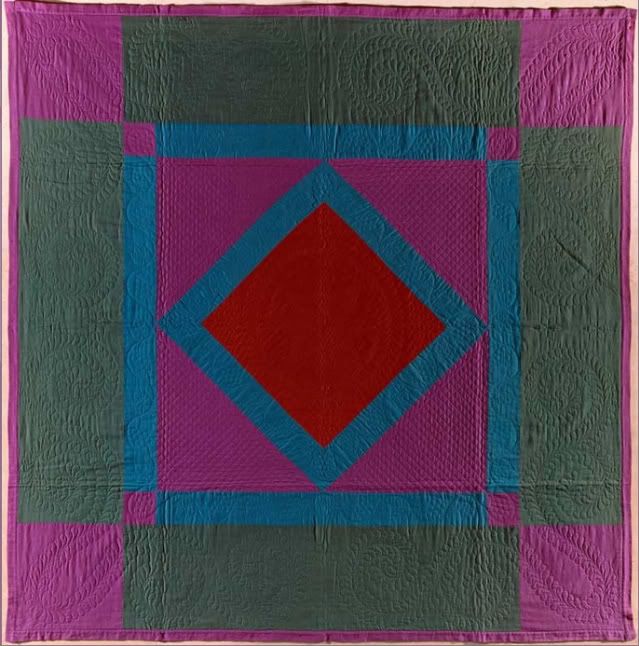
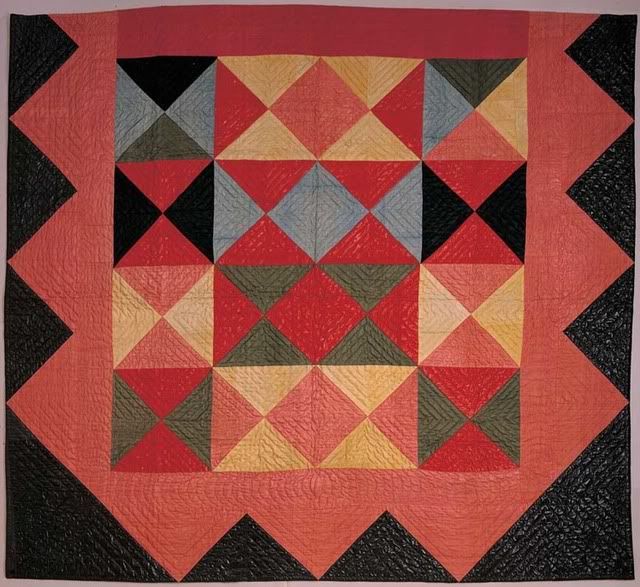


From top: Diamond in the Square Quilt, Artist unidentified, Lancaster County, Pennsylvania, 1910–1925, Wool, 78 x 78 in.
Harlequin Medallion Quilt, Artist unidentified, New England, 1800-1820, Glazed Wool, 87 x 96 in.
Bird of Paradise Quilt Top, Artist unidentified, Vicinity of Albany, New York, 1858–1863, Cotton, wool, and silk with
ink and silk embroidery, 84 1/2 x 69 5/8 in.
Double Wedding Ring Quilt, Artist unidentified, Probably Georgia, 1930–1940, Cotton, 86 1/4 x 72 in. (framed)
W IS FOR WILLA
 Finally finished my latest project, a handsewn and embroidered namesake pillow for my pal Kelly and her husband's new little girl Willa. W-W-W-Willa.
A STUD IS BORN

London, England, June 1966 / Photograph by James P. Blair, National Geographic
Not since Michael Jackson’s strong shoulders made us shudder and bow down to his majesty the king of pop circa 1994, have embellished shoulders on structured jackets had such a moment. Mini spikes and studs in a range of metals can be found on otherwise subdued blazers, jackets and coats this fall. Moving past the shoulder, bedazzlers have also made their way to the lapels and sleeves of the season’s best outerwear. If you’ve never been cool, here’s your chance to reconfigure your reputation and pair this bad-to-the-bone fall basic with feminine dresses, or just keep it minimal with a basic tee, skinny jeans and a pair of pumps.
BAZAAR
 When I was a little girl and should have been reading Seventeen, I was drooling over the glossy pages of Bazaar. Since then, after having been schooled in graduate fashion studies, and as the result of my own personal research, I appreciate the publication for three things: it's longevity (around since 1867, it's America's first fashion magazine), creative edge (has fearlessly collaborated with some of the greatest artists and photographers in recent history: Diane Arbus, Alexey Brodovitch, Andy Warhol, Martin Munkácsi), and daring editorials (the first action photographs to depict fashion were published in Bazaar).
I love this cover of the magazine from October 3, 1868. Most likely because I'm somehow always drawn to illustrations and photographs of hairpieces, ie. this Lorna Simpson.
 Wigs II, 1996-2006, Waterless lithographs on felt.
FASHION FILMS: Prét-à-Porter
In 1994 I was 12 years old. The 90s remind me of mocha brown lipstick, flowered dresses, combat boots and daisies, wishing I were a plaid-skirt wearing coed on the pages of thick slab fall fashion issues of Seventeen, Vogue and Harper's Bazaar... Linda Evangelista's haircut, day-glo Betsey Johnson editorials, Nirvana, that patchouli-scented vintage shop downtown where i purchased my favorite lime-green 60s shift dress and pink golf shoes- both of which, I still own.
After having made a habit of watching Style With Elsa Klensch since the late 80s, it was also a decade during which I became more familiar with the blatant marriage of fashion and film. Granted, MTV's House of Style with Cindy Crawford was dope, and I swooned over Cher Horowitz's magical closet in Clueless. But Robert Altman's Prét-à-Porter certainly gave me a healthy dose of Parisian fashion, murder and intrigue on the silver screen. Not to mention a really great song called "Here Comes the Hotstepper" by dancehall dirtbag Ini Kamoze. "No no we don't die/ Yes we multiply/ Anyone test will hear the fat lady sing."
After all, what 12 year-old could help but love the utterly profound nude fashion show at the end? I count it as a pivotal moment in my still developing artistic brain.
DELUXE
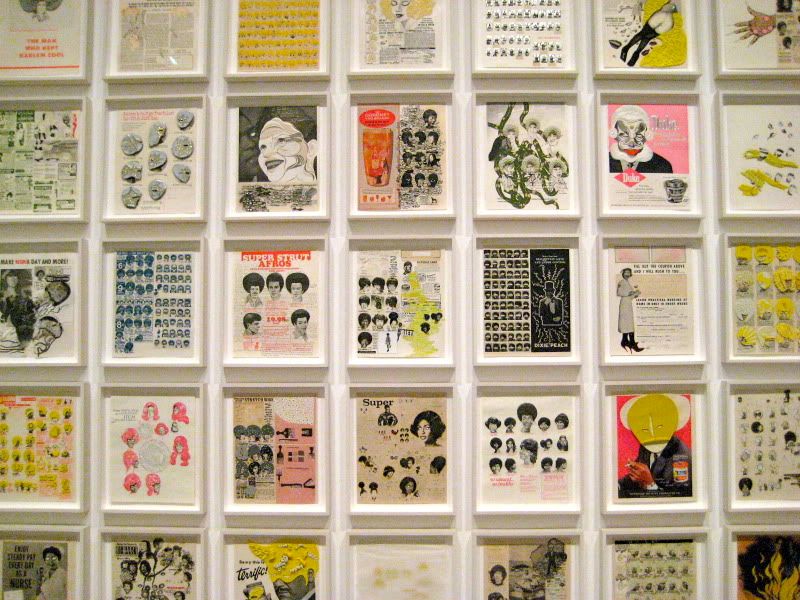
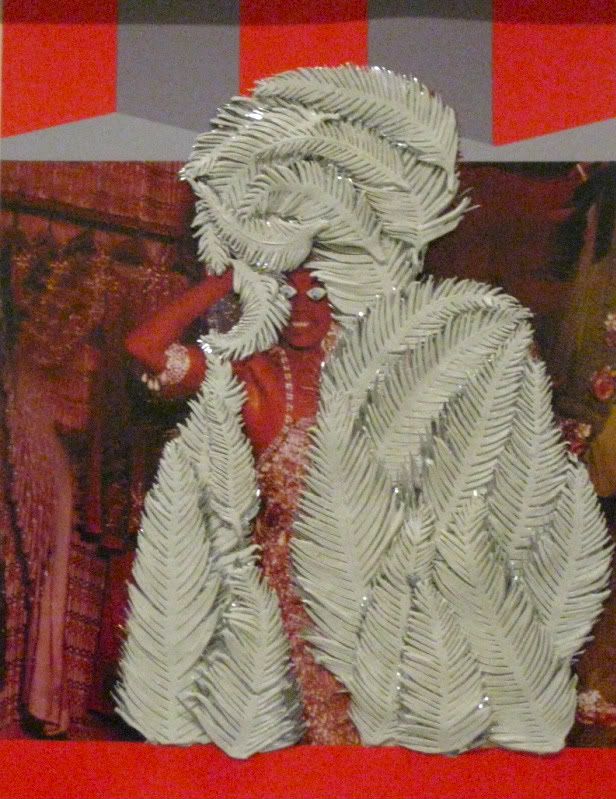
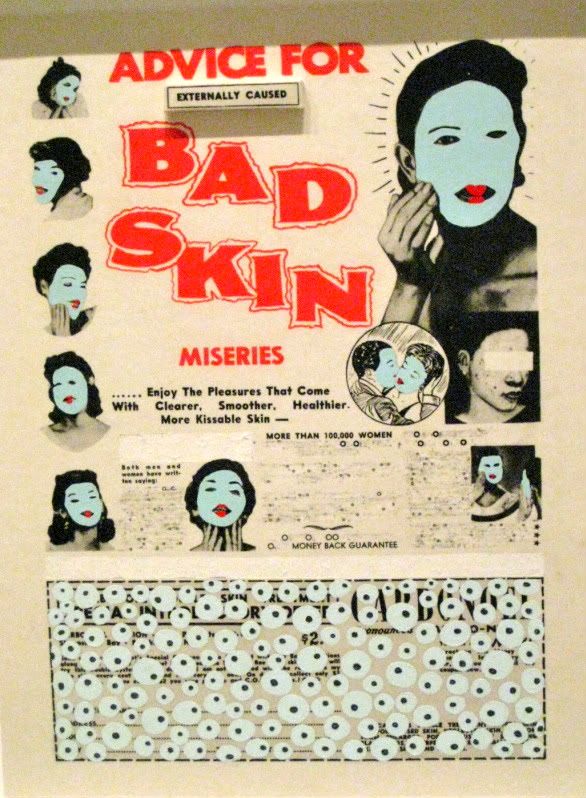
Pieces from Ellen Gallagher's Deluxe on display at the Museum of Modern Art. Some of my favorite artworks of all time, by far. Luckily I have the original text that accompanied the show when it premiered at the Whitney. It gets better every time I flip through it!
CURSE OF THE CAT PEOPLE
I watched this 1944 film quite often as a child, and the haunting atmosphere it created, like shimmering sequins in shadows, has stuck with me ever since.


Subscribe to:
Posts (Atom)